Driving in Japan


Our move to Japan has been exciting and nerve racking. Exciting in that we moved to JAPAN! Nerve racking in trying to figure what the Kanji stands for. Now you don’t need a care to get around with the great public transportation, but it is nice to have one when you have to drive the 35 km to Yokota or pick up a new 52” TV! But let’s talk about the process of buying one first.

The process of buying a car can be broken down into four simple steps, so what’s so hard about that? Well when everyone speaks broken English or what Kristina likes to call “ Japanese English” and you have no idea where to go or who to go to, it gets complicated. This is the breakdown of steps to go get a car.

1. Find a car that you like and put a down payment on it, generally 20,000 yen.
2. Get insurance on the car, which can cost up to $700 a year.
3. Then you take it to be inspected on base and get it cleared through the base.
4. Then you take it to the Land Office (LTO) and have them inspect the vehicle.
5. Once that's done, you have to purchase what is called Japanese Compulsory Insurance or JCI which you have to pay for every 2 years.

What we actually did was get a ride down to a used car dealership called Wellcham. I would say that about 80% of vehicles that are driven on base come from this place. The reason being is that they list car prices in US dollars and the price includes everything, i.e. JCI and the inspection at the LTO office. The only thing you really have to pay for is getting the base inspection done and insurance on your car. They basically un-complicate the process and that’s why they get 80% of the American business.

Now that we got a car we can go hit the streets and drive all crazy! Right? Unfortunately, not so much. The roads here are about ½ the size you would have in the states. Basically, Japan reduces what a two lane road we are use to about the size of alley ways in most cases. That’s why everyone here drives very tiny cars, well tiny compared to what Americans drive. You cringe when you see a H2 (yes, someone brought their Hummer here) or an F-150 roll up the street. Also, pedestrians and bicyclists love hogging the street. You will be driving down the street and then some person just walks out with no care in the world. You have to drive slowly through some areas because of there is no sidewalk to walk on, so people walk in the street. These two things were the hardest thing to get use to than actually driving on the left hand side of the road.

There are plenty of minor differences between here and America. Speed limits are in kilometers and not miles, which can be confusing especially when you get up to 80+ kph while it actually is 50 mph. Road signs really do not exit, and roads do not have names like back in the states. The only signs are ones for major routes, like highways. However, on these “highways” there are tons of cars making the 35 km to Yokota take at least an hour. I did not believe this until I was driven down Route 16, and trust me, it does take that long. Stopping point for intersections are generally 10 feet back from the actual intersection. This allows the bigger trucks to make the turns safely and causing no damage to other cars. But this means we cannot make a left hand turn (a right hand turn for you in the States) on a red light.

Car accidents happen all the time in Japan because of the massive amount of traffic. A big difference between the United States and Japan is that every driver is considered a professional driver. That means every time you put your keys into the ignition of your car, you take responsibility of any accident you are in. Everyone involved in an accident shares some of the blame. This is because if you did not get on the road in the first place, then there would not of been an accident. Crazy huh? So if you get T-boned while trying to make a right hand turn because the other driver failed to stop, you still get some blame. The insurance companies then battle it out in an octagon of death. Not really, but wouldn’t that be fun to watch?

If have any questions about driving in Japan, comment below and I’ll answer them to the best of my knowledge!

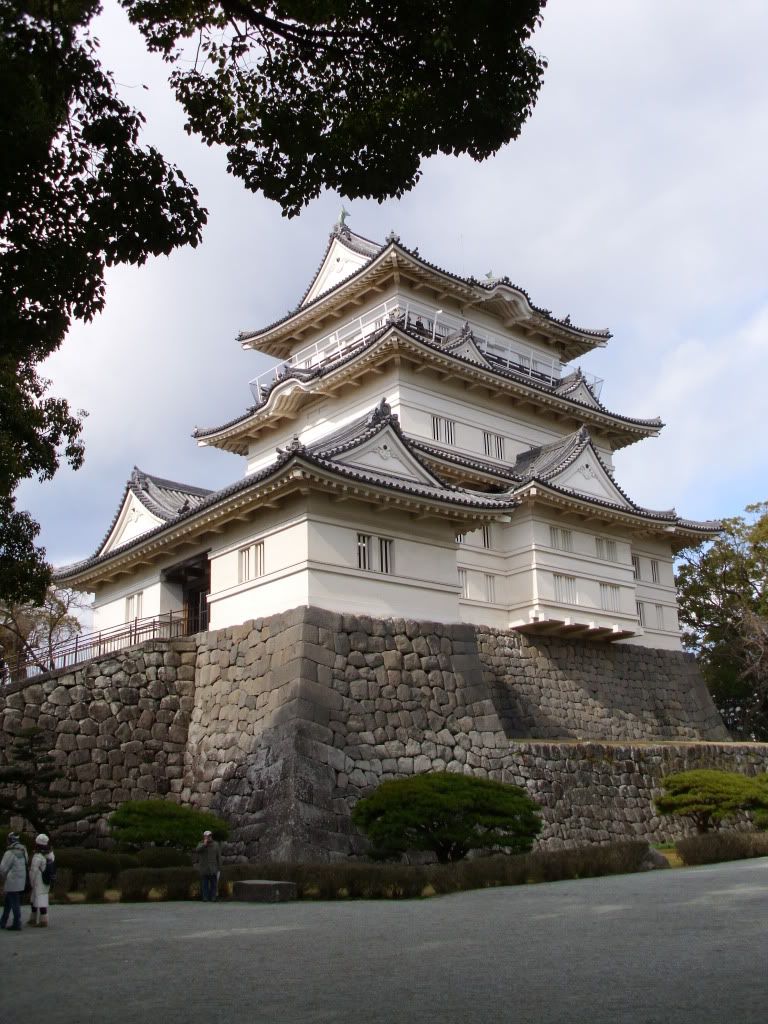
Japan History: Odawara Castle

Japan is an ancient culture compared to the states. Haden and I definitely understand this while visiting the Odawara Castle.

"For a little background history, Odawara Castle actually began in the 15th century with a stronghold built by the Omori Clan. After Hojo Soun conquered the area in 1495, he and his ancestors gradually expanded the castle as the Hojo clan gained power. At the height of their power, the Hojo controlled much of the Kanto area with support castles on the fringes in modern day Chiba, Ibaraki, Saitama, and Kanagawa prefectures.

Odawara Castle faced three major attacks by Uesugi Kenshin in 1561, Takeda Shingen in 1569 and Toyotomi Hideyoshi in 1590. The last siege by Toyotomi Hideoyoshi was the end of the Hojo clan's supremacy and the castle was turned over to Tokugawa Ieyasu.

In the final siege by Hideyoshi, he brought all his generals from around the country with about 200,000 troops to bear on Odawara Castle. In the leadup to the siege, the various generals took over Hojo castles and strongholds on their way to Odawara. As Hideyoshi closed the net around Odawawa he flaunted his strength by creating an almost festival like atmosphere with performances and tea ceremonies and he even brought in his concubine (Yodo-dono) and tea master (Sen no Rikyu). Hojo eventually conceded his defeat and turned over the castle with little bloodshed.

Once Tokugawa Ieyasu took control of the cstle, he stationed his vassal Okubo Tadayo as castle lord. Okubo reduced the size of the castle from the Hojo days because it representated a threat to the Tokugawa power. The Okubo family ruled over Odawara for the entire Edo Period except for a brief period in the 1700's. The castle was dismantled in 1870." ((http://www.jcastle.info/castle/profile/34f)

The Odawara Castle is like nothing Haden and I have ever seen. The architectural style is amazing and has a way of making you feeling apart of the history.


Machida: Little Tokyo

Machida, Japan but I like to call it little Tokyo. It's the shopping hub for our area and boy is it busy. Being only three train stops from us, when ever Haden and I want to get out of the house Machida is where we head.

One of my favorite places to go is the 100 Yen store. It is my all time favorite place to shop here in Japan. Five floors of pure shopping excitement. You can find anything and everything. Since shopping here in Japan is so expensive the 100 Yen store stays within our budget and everything is 100 yen or the equivalent of a dollar back home. Besides that there is a little side street that is filled with restaurants and food stands. Haden and I have made the goal to eat on the economy once a week so when we are in Machida lunch is always on the to-do list. Beef bowls, tempura or noodles there are always plenty to choose from. The hard part is choosing what to eat. Of course we have the obstacle of Japanese kanji so taking the risk and choosing random meals makes it that much more fun. The first time we went to Machida Haden and I discovered that there is a Japanese Walmart. They call it Seiyu but everything inside is Walmart brand. We also discovered a 7 story electronics store. It makes Best Buy look lousy. This place has everything. They even sell quality computer components for those who like to build computers. Its colorful and full gadgets that don't even exist in the states.

There is so much to do and see in Machida that every time we go we discover something new and interesting plus it's fun to walk around and immerse ourselves into the culture.


Trains, Trains & More Trains

Name of our train line

In the United States we rely on cars and trucks to get us from point A to point B. That is everyday living to us but in Japan modes of transportation are completely different. Not only by car or bus but for the majority of Japanese citizens the everyday commute involves one or multiple train rides. That said Haden and I had to reevaluate our mode of transportation and adapt to the Japanese style of travel. For two first timers taking the train would prove to be both challenging as well as an adventure in its self. The only way to really conquer the train riding lifestyle is to completely go for it. I have to admit it I was nervous the first time. Figuring out how to buy a ticket, where to put it in the turnstile and deciphering which train to take can be completely overwhelming for someone who is used to hoping in her Saturn and leaving a trail of dust. As for Haden well he was all about diving into the experience.

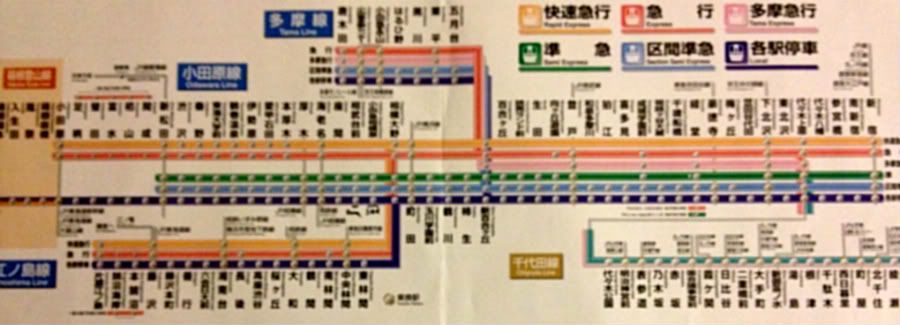
We know that our station is Sobudai-Mae, located a short walk from Camp Zama, and that becomes our starting point for all of our traveling. Our first ride would end us in the busy little town of Machida, one of the best shopping areas near us. There is just so much to remember when it comes to taking the train. A big one is knowing which train to get on so that you make it to your final destination. Haden and I have learned that the train you take is dependent on what direction you are traveling. For us to make it to Machida we travel North East, so getting on the right train means you take a train that stops at your destination. The key feature is that each train is named for its final stop. The train we take to Machida is the Shinjuku and for our return trip the train is Hon Atsugi. However we have to be careful when getting on a train because Japan offers multiple trains services that determine how fast you get to a destination and what stops it makes. For instance we take the "Local", which stops at every station on the line but there are trains that are designated as "Express" or "Rapid Express" which only stop at certain larger stations on the line. One thing we keep in mind is that when traveling farther distances the "Express" and "Rapid Express" will shorten our travel time. To give you a little perspective taking the "Local" takes two hours to get to Tokyo but if you take the "Rapid Express" it only takes you 30 minutes.
Map of Odakyu Train Line
There are plenty of rules and courtesies when you are actually on the train. For instance talking on your cellphone is prohibited and you are required to put your phone on silent or manner mode as they call it here. You also can't listen to your music loudly and talking is OK but in what we would call our six inch voice. Other things include giving up your seat to elders or women with small children. One thing that came to a surprise to Haden and I was how quiet the trains are. So quiet in fact people take naps without interruption. And as a shout out to my mother they have some very nice butt warming seats.

The pricing of a ticket depends on how far you're traveling but the type of train has no affect. For example from Sobudai-Mae station to Machida it costs 180 yen one way so 360 yen round trip. This comes out to be about 4 dollars for one person. There are several ways to purchase a ticket. You can either purchase your ticket for the exact amount from the departure station or purchase a cheaper ticket from the departure stations and pay the difference at the arrival station. Since people travel so much on the train system the companies offer train pass cards. For us there are two choices either the Pasmo Card or the Suica Card. Haden and I do quite a bit of traveling so we use the Suica Card for easy payment and faster travel. You generally put yen on the card and it deducts it every time you arrive at your final destination. To use the card its as easy as swiping it against the turnstile scanner and off you go.

Since our first tip on the train system our confidence has strengthened and we find that hoping on a train is just as easy as getting in our car. For us its a very economical way to travel and see Japan. With each trip we learn something new that makes it easier for our next trip and the fact that the trains are always on time it makes it very reliable.


No Place Like Home:Tour of Our TLF


Home is where the heart is and right now that is our TLF at Camp Zama.  Its nothing great but it gives us a place to sleep, relax and cook the occasional meal.  Its no more than a hotel room with a little kitchen but it serves a purpose until we have a house. I thought it would be fun to take you on a tour of our temporary home.


Category: , 0 comments

Hello From Japan

How you order ramen

Well hey everyone and greetings from Japan.  Man, it has been an eventful two weeks, Haden and I moved to a new country and boy is it different from the USA.  Let me start by saying one thing, Japan is CLEAN.  No trash or funky hot garbage smell, just clean.  We both need to work on our Japanese speaking skills, you don't realize how much you need to communicate until you simply can't do it.  This is the start of our little adventure or maybe more accurately BIG ADVENTURE.  We have already experienced a little Japanese culture, number one favorite for me, the food.  Not like anything I have ever had also it's nice to have actual real Japanese food.  Even better is how you order it.  There are these little shops that either serve ramen or rice bowls, when you order you put your yen in little machines, pick out your dish and give the ticket to the cook behind the counter.  Of course since Haden and I don't speak a lick of Japanese or read the characters its always a random selection.  Haden got lucky one day and ordered a beef bowl with kimchi.  I would have to say Haden's experience with it was a good one since it wasn't exactly what he wanted to order.  Number two would have to be the train system.  Riding on the trains is an adventure in it's self.  Sometime you are not sure if you are on the right train or even going in the right direction you just risk it and enjoy the ride. It will be exciting to find out what other simple adventures await for us. Next goal eat sushi.